
Midnight Marauder – ClusterBreaker: How ClusterBreaker Changes Classic Cluster Pays
Midnight Marauder – ClusterBreaker is a 2026 release from Relax Gaming that takes a familiar cluster-pays idea and changes what can happen inside each grid position. The game uses a compact 4×4 layout, yet its ClusterBreaker mechanic can split individual symbols into two, three or four matching parts, with those parts counting towards the minimum number required for a winning cluster. This matters because a conventional cluster game normally relies on the symbols already visible across separate positions, whereas Midnight Marauder can increase the effective number of matching symbols without making the grid physically larger. The mechanic remains active not only on the initial spin but also during subsequent winning generations, linking symbol splitting directly with cascades, a doubling multiplier and the game’s feature progression. Released on 25 June 2026, the slot has a maximum win capped at 10,000 times the regular stake, although RTP settings and some optional features can differ between operators and jurisdictions.
How ClusterBreaker Changes the Basic Cluster-Pays Formula
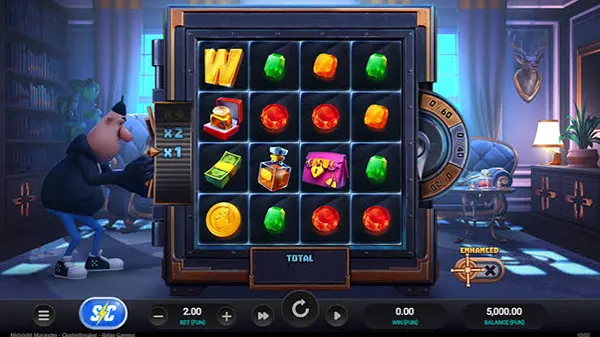
The starting point is still recognisable as cluster pays. Midnight Marauder – ClusterBreaker does not use fixed paylines for its main wins. Instead, a cluster is created when at least five matching symbols are directly adjacent to one another. Once a qualifying cluster has been formed, the game evaluates the win, removes the successful symbols and allows the remaining symbols to fall into the empty spaces. New symbols then enter from above, creating another generation within the same paid spin. If that new arrangement produces another cluster, the sequence continues. This cascading structure is familiar from many cluster slots, but the unusually small 4×4 grid makes every occupied position comparatively important. With only 16 main positions visible at the beginning of a generation, forming and extending groups would be much more restrictive if each position always represented exactly one symbol.
ClusterBreaker changes that relationship between grid size and symbol quantity. At every spin, intact symbols may be selected randomly and broken into two, three or four copies of the same symbol within their existing position. Those split parts are treated as individual matching symbols when the game checks whether the five-symbol threshold has been reached. A position that originally appeared to contribute one matching symbol can therefore contribute several after a break. The feature does not simply increase the payout attached to that original symbol; it changes the composition of the cluster itself. That distinction is important when comparing Midnight Marauder with a conventional cluster game, because ClusterBreaker affects whether a winning combination exists, how large it becomes and how many winning symbols can subsequently feed the collection features.
The splitting process is random rather than a choice made by the player, and an already broken symbol cannot be broken for a second time. The mechanic is nevertheless broader than it might first appear because the game rules allow all relevant symbols to be affected, including Wild and Coin symbols. Wilds continue to substitute for paying symbols when wins are determined, so splitting a Wild can have a different practical effect from splitting an ordinary jewel, cash or other paying icon. Coins become particularly important in the Coin Caper feature later in the game. The result is a system in which ClusterBreaker does not operate as an isolated visual event. It changes the number and type of useful symbol pieces present when the game evaluates the board, which is why the 4×4 layout can produce combinations that would normally require a considerably larger cluster grid.
Why Splitting One Symbol Is Different from Adding Another Reel
Expanding a slot from four columns to six or seven would give it more physical positions, but that is not what ClusterBreaker does. The mechanic preserves the compact board and changes the contents of selected positions instead. Imagine, for example, that several matching symbols are already touching but there are not enough individual symbols to reach the required total of five. If one of the matching intact symbols is broken into several parts, the count used for cluster evaluation can change without another full-size symbol having to land elsewhere. A borderline arrangement can therefore become a paying cluster as a direct result of the split. The exact outcome remains random, but this explains why watching only the number of large symbol tiles on the 4×4 grid does not tell the complete story.
This approach also changes the meaning of cluster size. In a conventional design, a larger cluster generally means that the same symbol occupies more separate cells across the board. Here, some of the total can come from several pieces occupying a position that began with a single intact symbol. The payout is still governed by the game’s paytable and the number of qualifying symbols, so the split does not guarantee a valuable result. It does, however, give the game another route towards the higher symbol counts used by the paytable. Because the mechanic can act on newly arriving symbols during later generations, a cascade may also develop in a way that could not have been predicted from the original 16 symbols shown at the start of the paid spin.
There is an important limit to keep in mind. ClusterBreaker creates additional matching pieces, but it does not turn every split into a win and does not remove the role of random symbol distribution. The resulting pieces still need to contribute to a valid cluster, and a generation can end without another qualifying combination. This makes the mechanic better understood as a change to the way potential clusters are assembled rather than as a guaranteed win booster. It also helps explain the game’s uneven rhythm: some spins can finish quickly, while another can move through several breaks, clusters and replacements from a single initial stake. The compact grid makes that contrast particularly visible because a relatively small number of successful changes can substantially alter what is happening on screen.
Cascades, the Multiplier Wheel and Brute Force Progression
ClusterBreaker becomes more significant once it is considered together with cascading wins. After a winning cluster is removed, the symbols above it drop down and new ones are added. ClusterBreaker can activate again during these later generations, meaning the mechanic is not limited to preparing the first cluster of a spin. An intact symbol arriving after a cascade can itself be selected for a split, potentially helping another group reach the five-symbol minimum. That second win removes another group and starts another generation. In practical terms, the mechanic can therefore help a spin continue rather than merely influencing its first result. This is one of the clearest differences between Midnight Marauder and a simpler cluster slot in which the board only changes through the removal and replacement of already existing symbols.
The Multiplier Wheel gives those repeated generations an additional role. It begins at 1× and doubles after each winning generation, up to a stated maximum of 1,024×. Importantly, the multiplier displayed for the current generation is applied before the wheel doubles for the next successful generation. A sequence therefore develops progressively: the first qualifying generation begins at the current baseline, a further win raises the level, and an extended cascade can continue moving through higher values. Reaching the upper limit would require an exceptionally long successful sequence, so the 1,024× figure should be viewed as a mechanical ceiling rather than a routine result. The important everyday effect is simpler: later wins within the same continuing sequence can be multiplied more strongly than the earliest win.
This creates a direct relationship between symbol splitting and multiplication. ClusterBreaker does not multiply a payout by itself, but a successful split can help produce another cluster; another cluster can create another cascade; and another winning generation moves the multiplier further along its doubling sequence. The mechanic therefore works as part of a chain rather than as a standalone payout modifier. A modest split may be more important when it occurs several generations into an active sequence than when it appears on a spin that immediately ends, because preserving the chain keeps the multiplier progression alive. At the same time, the random nature of each stage means there is no reliable way to forecast how long a sequence will continue. The visual momentum of repeated splits and cascades should not be mistaken for a predictable pattern.
How the 20, 40 and 60 Symbol Milestones Affect a Spin
Winning symbols have another purpose beyond their immediate cluster value: they are collected towards the Brute Force progression during the same spin. The first important threshold is reached after 20 collected winning symbols, activating Brute Force. Collecting a further 20 advances the feature to its second stage, while reaching a total of 60 winning symbols in that single spin activates Smash ‘N’ Grab Free Spins. This system makes the number of individual symbols removed from winning clusters important in its own right. A split that contributes several pieces to a successful cluster can therefore influence both the current payout sequence and progress towards the feature thresholds. That is another reason ClusterBreaker changes more than the visual size of a winning group.
The collection requirement also shows why repeated generations matter so much in Midnight Marauder. Reaching 60 winning symbols on a grid that begins with only 16 main positions depends on substantial activity during one continuing spin. Symbols need to form clusters, disappear, be replaced and potentially split as the sequence develops. The counter therefore rewards the cumulative volume of winning symbols rather than simply asking for one particular Scatter combination to appear. In a traditional free-spins trigger, players normally watch for a fixed number of special symbols on the reels. Here, bonus progression is partly tied to the amount of successful cluster activity generated during the cascade sequence itself, making ClusterBreaker and the collection meter closely connected.
When the 60-symbol target is completed, Smash ‘N’ Grab begins with eight free spins and an 8× baseline multiplier. The baseline is important because it replaces the usual 1× starting point for wins during the feature. The multiplier can still double through consecutive winning generations and can still rise as high as 1,024×. Once an individual free spin finishes, however, the multiplier returns to the applicable baseline for the next spin rather than retaining the highest level reached in the previous sequence. This keeps the same central logic as the base game while giving the free-spins round a higher starting level. ClusterBreaker remains relevant because continued splitting can contribute to new clusters, further generations and renewed progress through the Brute Force collection stages during the bonus.
How ClusterBreaker Works Inside the Main Bonus Features
The clearest example of ClusterBreaker being adapted for a different purpose is the Coin Caper Bonus. Five Coin symbols landing in the base game can trigger this round, and the triggering coins are carried into the feature. The player begins with three lives, and each new Coin that lands resets the counter to three. ClusterBreaker remains active, but its role changes because the focus is now on Coins rather than ordinary paying symbols. The Mr Midnight symbol can select intact positions and break them into two, three or four Coins of the same value. When at least five Coins form a qualifying group, their individual values are absorbed into a single Coin and added together. This simultaneously consolidates their value and creates more space for the feature to continue.
The Coin Caper also has its own interaction with the Multiplier Wheel. It begins at 1× and doubles whenever a Coin cluster is absorbed, again up to 1,024×. Rather than simply multiplying each ordinary cascade win, the final multiplier shown on the wheel is applied to the combined value of the Coins when the bonus ends. The feature finishes after three consecutive rounds fail to add another Coin. ClusterBreaker therefore serves a somewhat different purpose here: instead of primarily increasing the size of paying symbol groups, it can increase the number of same-value Coins and help create groups that are then merged. The core idea remains recognisable, but the mechanic has been adapted to a collection and consolidation bonus rather than copied unchanged from the base game.
Smash ‘N’ Grab provides the other major interpretation of the mechanic. Its standard natural trigger awards eight free spins with an 8× baseline multiplier, but the rules also offer an optional gamble before the round begins. Each successful gamble doubles the baseline multiplier and adds one additional free spin. Up to five gambles can be attempted, meaning a completely successful sequence can lead to 13 free spins with a 256× baseline. The trade-off is substantial: accepting the gamble and losing it forfeits the free-spins round and returns play to the base game. This is not a strategy that improves the mathematical certainty of an outcome; it is an optional risk decision. Availability can also depend on local rules, so players should rely on the version of the game and help information shown by their casino rather than assuming every feature is present everywhere.
What the Mechanic Means for RTP, Volatility and Actual Play
ClusterBreaker makes Midnight Marauder more eventful mechanically, but it does not change a basic principle of slot mathematics: more visible activity does not mean that a particular session will return more money. RTP is calculated statistically across a very large number of rounds, and individual results can vary substantially. Published configurations of Midnight Marauder – ClusterBreaker are not identical in every market. Many 2026 game listings report a 96.10% RTP configuration, while the PokerStars Italy rules available for the game specify a 94.00% theoretical RTP for regular play and 94.50% for listed feature-buy options. This difference is a useful reminder to check the information panel of the actual version being played. The operator’s in-game rules are more relevant than an RTP figure copied from a general game listing.
The game’s maximum payout is capped at 10,000× the regular stake. If a result would exceed that limit, the published rules state that the round is stopped and the 10,000× maximum is awarded. That figure should not be treated as an indication of a typical return. Midnight Marauder is commonly classified in 2026 game listings as medium-high to high volatility, which fits a design containing long cascade chains, strongly escalating multipliers and bonus rounds with very high potential baseline values. ClusterBreaker can make a spin appear unusually active because a single position can be divided into several counted symbols, yet long sequences without a large return remain possible. The mechanic changes how combinations form; it does not make the outcome controllable or remove the variance associated with the slot.
What ultimately separates Midnight Marauder – ClusterBreaker from a conventional cluster-pays game is the way it makes symbol quantity flexible. A classic grid normally asks the player to wait for enough matching full-size symbols to occupy neighbouring positions. Here, selected symbols can become several matching parts, those parts can help create or enlarge clusters, successful clusters can generate cascades, and newly arriving symbols can be broken again if they are still intact. The same process feeds the Brute Force counter, supports the doubling multiplier and is reworked for Coin Caper and Smash ‘N’ Grab. The result is not an entirely different definition of cluster pays: five or more directly adjacent matching symbols are still the foundation. ClusterBreaker changes the route by which the game can reach that threshold and the amount of progression that may follow once a winning sequence has begun.
Popular articles
-
 Helios – Triple Sun by Pragmatic Play: How Three Scatter Modifiers Wor...
Released by Pragmatic Play on 14 September 2026, Helios – …
-
 Super Serge by Pragmatic Play: 4,096 Ways to Win, Three Wild Modifiers...
Released in August 2026, Super Serge is a Pragmatic Play …
-
Midnight Marauder – ClusterBreaker: How ClusterBreaker Changes Classic...
Midnight Marauder – ClusterBreaker is a 2026 release from Relax …
-
 Buildin’ Even More Bucks: How Construction Meets the Search for Lost T...
Buildin’ Even More Bucks takes an unusual approach to the …